
Pre-K education is an important period that plays a critical role in children’s development and provides a solid foundation for their future education. During this period, children develop their academic skills while also making great progress socially, emotionally and physically.
The values and opportunities that pre-k education provides to children have the potential to shape their future. Let’s take a closer look at the benefits of pre-k education and discover the effects of this important period on children.
What is Pre-K Education?
Pre-K education is an educational process that supports the development of children, usually between the ages of 3-6, and prepares them for primary education. During this process, children develop their cognitive, social, emotional, language and motor skills. They also begin to gain important life skills such as problem solving, creativity and critical thinking.
During the pre-k period, children begin to learn academic subjects such as basic math, language and science skills, while also developing social skills such as sharing, collaborating, problem solving and emotional management. Quality education provided in this early period helps children be more successful in their later educational lives.
Importance of Pre-School Education
Pre-K education is an important period in which children acquire the basic skills they need to overcome the challenges they will face throughout their lives. During this period, children show great development in social, emotional, cognitive and physical areas.
Generally, pre-k education helps children develop in many areas such as language, mathematics, social and self-care skills. In addition, pre-k education develops children’s personal characteristics such as self-confidence, empathy, cooperation and leadership.
👉 Stonebridge Academy is an organization specialized in pre-k education in McKinney, TX. It provides education, materials, documents, advertising support and nursery consultancy services to kindergartens and nurseries. It also provides the same quality education to its member kindergartens by supporting them with documents, training, healthy menus and branch lessons prepared by academic consultants.
Important benefits of pre-k education
In childhood, 70% of intelligence development is completed by the age of 7. Learning skills also develop at this age. The role of pre-k education in establishing education on solid foundations has also been scientifically proven. Children between the ages of 3-6 experience the greatest change and development at these ages. The child’s motor skill process should also be defined by the age of 6 so that he/she can use these abilities in later ages.
Therefore, the pre-k education process is both important and necessary for children and parents. The contribution of this period to the child’s social, physical and mental development is quite great.
Many national and international studies have shown that children who receive pre-k education have higher academic success. Today, the continuity of active working life and the fact that parents have become more conscious about education have led to an increase in the importance given to pre-k education. Many developments and changes begin in the child during the pre-k education process. These can be listed as follows:
- ✅ 70% of intelligence development is completed by the age of 7;
- ✅ Learning skills such as attention, memory, and problem-solving improve rapidly;
- ✅ Establishes a strong foundation for lifelong academic success;
- ✅ Supports the development of motor skills before age 6;
- ✅ Strengthens social, physical, emotional, and cognitive development;
- ✅ Enhances language acquisition and communication abilities;
- ✅ Helps children transition smoothly into primary school;
- ✅ Promotes healthy self-care and independence;
- ✅ Encourages discovery of talents and interests;
- ✅ Boosts self-confidence and emotional resilience;
- ✅ Builds cooperation, responsibility, and sharing habits;
- ✅ Reinforces basic values such as respect and empathy;
- ✅ Encourages sports habits and physical activity;
- ✅ Helps children learn how to function in group settings;
- ✅ Increases school readiness and long-term academic performance;
- ✅ Meets the growing needs of modern working families.
At the same time, the child’s ability to share develops. social and emotional development progresses, eating habits develop, language skills develop. self-confidence increases, creativity develops. Through games, they learn to reason, solve problems and develop motor skills. In addition to all these, pre-k education allows the child to adapt more easily to the transition to primary school. This process also contributes greatly to the development of concentration.
Another of the most important issues is that thanks to pre-k activities, problems such as attention deficit and learning difficulties in the child are detected early and the necessary precautions are taken.
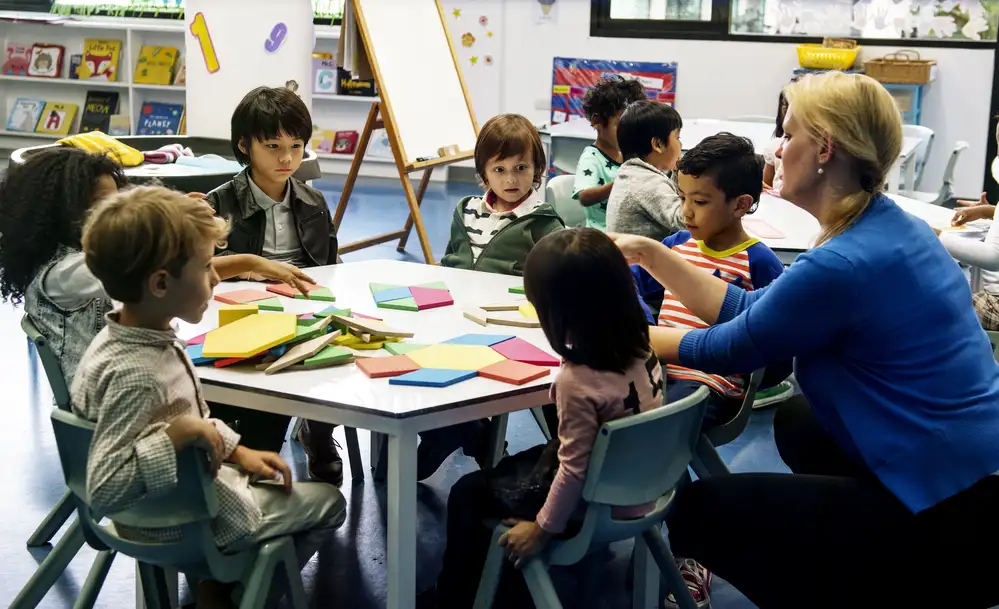
Learning centers are also very important in pre-k education. Learning centers are areas where children’s free play needs are met. The teacher prepares these centers before the children come to class, and the child who chooses the learning center continues to work according to their interests and desires.
When they are done working, they can move on to the next center. These centers allow children to live different experiences effectively, gain problem-solving skills, express themselves, share, cooperate, make decisions and take responsibility, and fulfill the responsibilities they have taken.
Another important issue in the pre-k period: Family participation
Family participation, which is an important part of the pre-k education program, is the whole of the activities organized for mothers and fathers to contribute to the development and education of their children. Family participation, which should be planned and implemented in a way that covers the child’s entire life at school, in the family and in society, provides many benefits to both the parent and the child.
Studies show that the active participation of the family in the education of children, especially in the pre-k period, contributes to the child’s acquisition of knowledge and skills that support their development, the positive change of the learning environment at home, the support of cognitive development and preparation for school, and the increase in school success.
Among the family participation activities; information meetings, home visits, family participation in in-class and out-of-class activities, home learning, family participation in the institution’s program, and family participation in the decision-making process.
Give Your Child a Head Start!
What Does pre-k Education Provide to Children?
Pre-k education plays a very important role in the development of children and provides them with many gains. We can list these gains as follows:
🧠 Cognitive Development
- ✅ Improves language and communication skills.
- ✅ It improves problem-solving, critical thinking and creative thinking skills.
- ✅ It helps them learn numbers, letters and symbols.
- ✅ Develops early reading and writing skills.
- ✅ It increases the desire to acquire knowledge and learn.
😊 Social and Emotional Development
- ✅ It helps them make friends and socialize.
- ✅ They learn to share, help and cooperate.
- ✅ They develop the ability to recognize and express their emotions.
- ✅ They develop their sense of self-confidence and self-esteem.
- ✅ They learn to follow rules and be disciplined.
🏃 Motor Development
- ✅ They develop gross and fine motor skills.
- ✅ They improve coordination and balance skills.
- ✅ They learn to control their energy and coordinate their movements.
🎯 Other Achievements
- ✅ They improve their self-care skills.
- ✅ They acquire healthy eating and hygiene habits.
- ✅ They become conscious of nature and the environment.
- ✅ They discover their talents in areas such as art and music.
- ✅ They develop their self-expression and communication skills.
Benefits of Stonebridge Academy pre-k Education
Stonebridge Academy allows children to use their mental potential at the highest level, improving their attention and focus skills in an extraordinary way. This program makes children a real treasure in the mental sense by providing them with the ability to analyze and solve problems. Moreover, this education model increases children’s self-confidence incredibly; it instills in them the confidence that they can overcome any difficulty.
As the best pre-k education center in McKiney, TX, we also provide children with study discipline and regular study habits. This provides a great advantage for children in their future education. However, one of the most impressive aspects is that the program awakens a natural curiosity and passion for learning in children.
Our pre-k education center not only encourages children to learn, but also supports this curiosity and passion at every opportunity, ensuring that they approach knowledge with hunger and enthusiasm.
Also, we not only play a critical role in shaping children’s futures, but also equip them with incredible self-confidence, mental acuity and an endless desire to learn, turning them into real leaders.
Frequently asked questions about Pre-K Education Benefits
What is Pre-K education and why is it important?
Pre-K education refers to structured early childhood learning for children ages 3–6, preparing them for kindergarten and beyond. It supports emotional, cognitive, social, and motor development. Quality Pre-K lays the foundation for academic success, social confidence, and lifelong learning habits.
How does Pre-K education help with kindergarten readiness?
Pre-K helps children develop critical skills like language, basic math, emotional regulation, sharing, and motor coordination. These skills make the transition to kindergarten smoother and ensure children are better prepared academically and socially from day one.
What are the key benefits of enrolling in a Pre-K program in McKinney, TX?
Some major benefits include: improved academic performance, enhanced self-care and communication skills, early detection of learning difficulties, stronger social interactions, and exposure to structured routines. Local centers like Stonebridge Academy provide holistic learning through expert-designed programs and activities.
How does family participation impact Pre-K education success?
Active family participation boosts learning outcomes, enhances emotional security, and bridges school-home connections. Activities like home visits, classroom engagement, and shared learning tasks support both the child’s development and parent-school collaboration.
Why choose Stonebridge Academy for Pre-K education in McKinney?
Stonebridge Academy offers a research-backed curriculum, trained educators, engaging learning centers, and personalized attention. The academy nurtures confidence, focus, creativity, and academic readiness while providing a safe, inclusive, and inspiring environment for early learners.